

Airline Weather
Industry Solutions
Explore real-world use cases and solutions tailored to each industry's unique weather challenges.


Construction Weather

Logistics Weather

Facility & Plant Weather

Municipal Weather

Retail Weather

Energy Weather

Dam Weather

Insurance Weather

Agricultural Weather

School Weather

Event Weather

Sports Weather

Road Weather

Railway Weather

Climate Tech

Broadcasting Weather

Coastal Weather

Airline Weather

General Aviation Weather

Drone Weather
Weather Solutions
Industry Solutions
Top PageWeather Solutions
Wind Characteristics and Operational Strategies at Narita International Airport (RJAA/NRT)
February 25, 2026 Weathernews
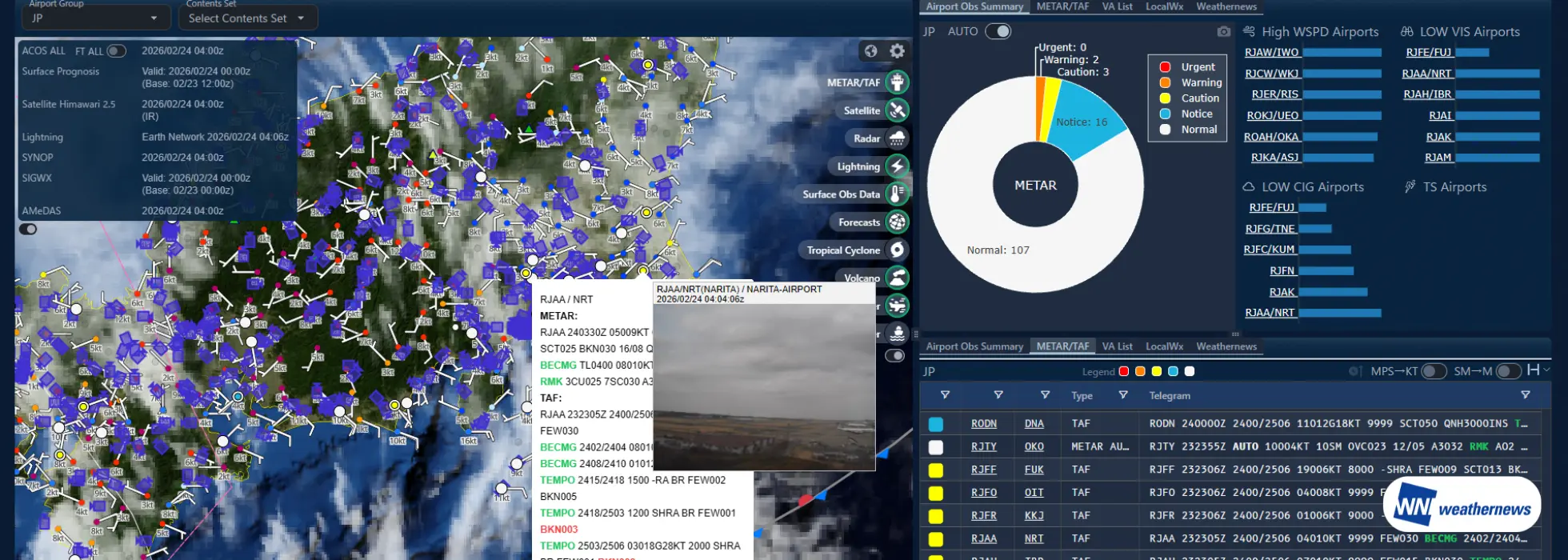
Narita International Airport (RJAA/NRT) is an international hub airport located in Narita City, Chiba Prefecture, in the eastern part of the Greater Tokyo area, Japan.
At Narita Airport, the prevailing wind direction shows significant seasonal variability. In particular, spring (March–May) is not only the peak season for inbound travel to Japan due to the cherry blossom period, but also a time when rapid wind shifts and gust risks tend to increase as air masses transition. Therefore, accurately understanding wind characteristics is essential for effective operational planning.Strong winds of 20 knots or higher are observed throughout the year at Narita Airport, with the highest frequency occurring in March.
Narita Airport is situated on the Hokuso Plateau, which extends southwest to northeast across the northeastern part of Chiba Prefecture in the eastern Kanto Plain, at an elevation of approximately 40 meters. Although there are no mountains within a 60 km radius, small valleys and rivers lie to the north and southeast of the airport—roughly aligned with the runway orientation—creating uneven terrain that tends to induce airflow disturbances. In addition, the airport is located about 20 km inland from the Pacific coast, and thus exhibits inland climate characteristics such as a relatively large diurnal temperature range. These geographic features have a notable influence on the airport’s weather. From the northeast to northwest of the airport, large green areas including rivers and lakes—such as Lake Kasumigaura, the Tone River, and Lake Inbanuma—together with extensive farmland, act as sources of water vapor and contribute to humid conditions. The surface soil of the Hokuso Plateau consists of the fine-grained volcanic ash known as the Kanto Loam Layer. In early spring, when crop cover is limited, this soil is easily lifted by strong winds, making the area prone to blowing dust.
① The representative wind reported in METAR and TAF corresponds to observations at the south end of Runway A (near the RWY34L touchdown zone).
② The annual wind directions can be broadly classified into the following three patterns
②-1 Northwesterly winds associated with the winter monsoon
②-2 Southerly winds associated with the summer monsoon and lows over the Sea of Japan
②-3 Northeasterly (north to northeast) winds associated with south-coast low-pressure systems
③ On days not affected by significant weather disturbances, a diurnal variation in wind direction is observed: southerly winds tend to prevail during the daytime, while northerly winds prevail at night.
④ The most frequently observed wind direction is 010°–030°, while the least frequent is 250°–260°.
⑤ South-southeasterly (SSE; 140°–170°) winds also occur relatively often. Easterly and westerly winds are comparatively infrequent.
⑥ The annual mean wind speed is 6.4 KT, and the most frequently observed wind speed is 4 KT.
⑦ Mean wind speeds of 6.4 KT or higher most often occur with wind directions of 340°–070°, 190°–240°, and 300°–320°. In other words, northwesterly and northeasterly winds are both frequent and relatively strong. Although southwesterly winds occur only about half as often as northwesterly or northeasterly winds, they frequently exceed 10 KT on average and are stronger than winds from other directions.
① Wind directions associated with strong winds (≥15 KT) can be broadly grouped into three sectors: 010°–040° (northeasterly), 210°–230° (southwesterly), 300°–320° (northwesterly)
② The wind directions associated with strong winds vary by season.
③ Regarding duration, about half of strong-wind events last 2 hours or less, and roughly 80% last 5 hours or less. However, about 8% persist for more than 8 hours. The longest event lasted 42 hours, associated with a south-coast low in April 1985.
④ The annual average number of days with a daily maximum wind speed of ≥20 KT is 39.3 days, while days with ≥30 KT average 2.3 days per year.
⑤ Strong winds of ≥20 KT are observed throughout the year, but they occur more frequently from January through April and less often from June through August. The peak month is March, averaging 6.2 days.
In METAR reports, gusts are observed approximately 200 times per year on average. About 85% of these events end within 1 hour, and roughly 93% end within 3 hours. However, cases lasting more than 10 hours occur about twice per year on average, with the longest event lasting 19 hours, associated with a south-coast low in May 1997.
Explore real-world use cases and solutions tailored to each industry's unique weather challenges.
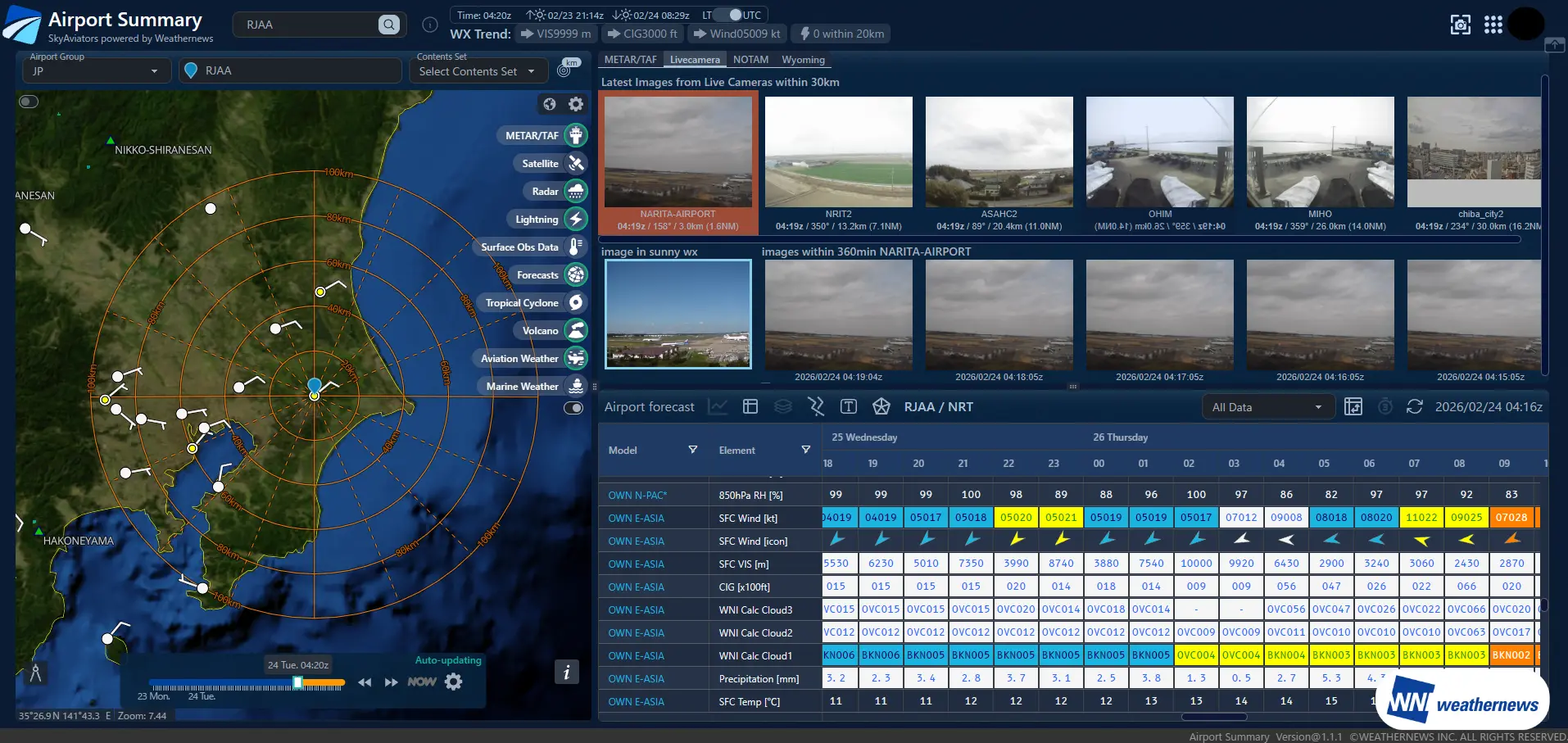
SkyAviators is a comprehensive weather intelligence platform developed by Weathernews for airlines. Powered by world-class meteorological data and decades of aviation weather expertise, it empowers operational decision-making when it matters most. The Airport Summary & Model Comparison feature integrates multiple numerical weather prediction models and ICAO-standard forecast reliability assessments into a single view. This enables users to quickly identify forecast discrepancies and uncertainty, supporting weather interpretation and decision-making aligned with airline operational policies.
Multiple numerical weather prediction models—including regional models, global models, and proprietary forecasts—are consolidated into a single view together with historical observation data.
Forecast reliability for each numerical model is visualized using evaluation methods based on ICAO standards.
Three numerical weather prediction models for the same region are displayed in parallel, enabling direct comparison under identical conditions.
Historical observations, current conditions, and future forecasts are seamlessly integrated into a time-series display.
Objective reliability assessments clarify which model should be used as the decision reference. This improves both the speed and confidence of Go / No-Go decisions, helping prevent delays in operational judgment.
Model reliability is standardized using ICAO-based evaluation methods, reducing reliance on individual expertise or personal judgment. This allows the entire team to apply consistent decision criteria.
When weather variability is high and decisions become challenging, multiple forecast models are compared and their confidence evaluated to provide reliable support for operational decision-making.
There is no need to switch between multiple websites or screens. By consolidating all relevant information into a single view, analysis time is reduced, allowing teams to focus on making decisions.
Please feel free to consult with us about implementation methods, features, or advancing specific considerations. We'll answer even the smallest questions.
We'll explain pricing details and provide specific content based on your site conditions so you can consider with confidence.
Free Quote
We'll explain in detail how to utilize features and the implementation process. Please feel free to consult with us.
Consider Implementation