

Airline Weather
Industry Solutions
Explore real-world use cases and solutions tailored to each industry's unique weather challenges.


Construction Weather

Logistics Weather

Facility & Plant Weather

Municipal Weather

Retail Weather

Energy Weather

Dam Weather

Insurance Weather

Agricultural Weather

School Weather

Event Weather

Sports Weather

Road Weather

Railway Weather

Climate Tech

Broadcasting Weather

Coastal Weather

Airline Weather

General Aviation Weather

Drone Weather
Weather Solutions
Industry Solutions
Top PageWeather Solutions
Heavy Snow and Strong Winds to Impact the Eastern US; Widespread Severe Weather Expected from Feb. 20
February 20, 2026 Weathernews

From February 20 through 24, a transition to a more active weather pattern is expected across the United States.
Heavy rainfall is anticipated along the Pacific coast from February 22 onward. In the Northeast, the combination of an upper-level cold trough and a surface low-pressure system advancing northeastward along the East Coast with an associated frontal system is expected to bring heavy snowfall and strong winds from February 22 through 23. Widespread impacts on aviation operations are a concern, with the potential for significant operational restrictions and cascading delays at major airports.
Snowfall is expected to begin at Washington and Philadelphia airports from the 22nd, and at Newark, New York, and Boston airports from the 23rd. Accumulated snowfall through 00Z on the 24th is generally expected to reach 10 cm or more across these areas. Philadelphia airport, which is particularly prone to active snow bands, could see record-breaking snowfall approaching 50 cm. Strong northerly winds are expected, especially at airports closer to the coast, and snowfall at Boston airport may continue beyond 00Z on the 24th. In addition to deteriorating road conditions due to snow accumulation and freezing, caution is also warranted for reduced visibility caused by intensifying snowfall and blowing snow. The risk of freezing rain or ice pellets associated with warm air intrusion aloft is considered low.
Airport
Washington Dulles International Airport
Ronald Reagan Washington National Airport
Philadelphia International Airport
Newark Liberty International Airport
LaGuardia Airport
John F. Kennedy International Airport
Boston Logan International Airport
City
Washington, DC
Washington, DC
Philadelphia
Newark
New York
New York
Boston
ICAO/IATA
KIAD / IAD
KDCA / DCA
KPHL / PHL
KEWR / EWR
KLGA / LGA
KJFK / JFK
KBOS / BOS
Snow Timing (by 0000 UTC 24 Feb)
from 0300 UTC 22 Feb to 2100 UTC 23 Feb
from 0300 UTC 22 Feb to 2100 UTC 23 Feb
from 0900 UTC 22 Feb to 0000 UTC 24 Feb
from 0000 UTC 23 Feb to 2100 UTC 23 Feb
from 0000 UTC 23 Feb to 0000 UTC 24 Feb
from 0000 UTC 23 Feb to 0000 UTC 24 Feb
from 0300 UTC 23 Feb to 0000 UTC 24 Feb
Peak Snowfall Period
from 2100 UTC 22 Feb to 0600 UTC 23 Feb
from 2100 UTC 22 Feb to 0900 UTC 23 Feb
from 0000 UTC 23 Feb to 1800 UTC 23 Feb
from 0300 UTC 23 Feb to 1500 UTC 23 Feb
from 0600 UTC 23 Feb to 1800 UTC 23 Feb
from 0600 UTC 23 Feb to 1800 UTC 23 Feb
from 1500 UTC 23 Feb to 0000 UTC 24 Feb
Low VIS / CIG due to Snow Period
from 2100 UTC 22 Feb to 0600 UTC 23 Feb
from 2100 UTC 22 Feb to 0900 UTC 23 Feb
from 0000 UTC 23 Feb to 1800 UTC 23 Feb
from 0300 UTC 23 Feb to 1500 UTC 23 Feb
from 0600 UTC 23 Feb to 1800 UTC 23 Feb
from 0600 UTC 23 Feb to 1800 UTC 23 Feb
from 1500 UTC 23 Feb to 0000 UTC 24 Feb
Forecast Snowfall Amount (by 0000 UTC 24 Feb)
15-20cm
20-30cm
40-50cm
15-20cm
15-20cm
10-15cm
20-30cm
Strong Winds ≥ 20 kt
NIL
NIL
from 0600 UTC 23 Feb to 1500 UTC 23 Feb
NIL
from 0300 UTC 23 Feb to 2100 UTC 23 Feb
from 0300 UTC 23 Feb to 2100 UTC 23 Feb
from 0600 UTC 23 Feb to 0000 UTC 24 Feb
Minimum Temperature During Snowfall
-1℃ (from 0400 UTC 23 Feb to 1400 UTC 23 Feb)
-1℃ (from 0500 UTC 23 Feb to 1400 UTC 23 Feb)
-1℃ (from 0500 UTC 23 Feb to 1700 UTC 23 Feb)
-2℃ (from 1400 UTC 23 Feb to 1700 UTC 23 Feb)
-1℃ (from 1300 UTC 23 Feb to 2100 UTC 23 Feb)
-1℃ (from 1300 UTC 23 Feb to 2100 UTC 23 Feb)
-3℃ (from 1900 UTC 23 Feb to 0000 UTC 24 Feb)
Large-scale flight cancellations during winter are often not the result of unforeseen weather. Instead, they often come down to a critical challenge: how to assess forecast reliability within limited decision-making time.
・Even after reviewing the TAF, confidence in the forecast may remain uncertain. ・Numerical weather prediction models can provide additional support, but it is often unclear which model should be prioritized. ・There is little time to check historical performance or consistency across multiple models.
For aviation operations teams, the ability to instantly compare, evaluate, and interpret multiple sources of information has become more essential than ever. What airlines truly need is a simple, intuitive indicator that allows them to quickly and confidently answer one key question: How reliable is the forecast for this airport?
Explore real-world use cases and solutions tailored to each industry's unique weather challenges.
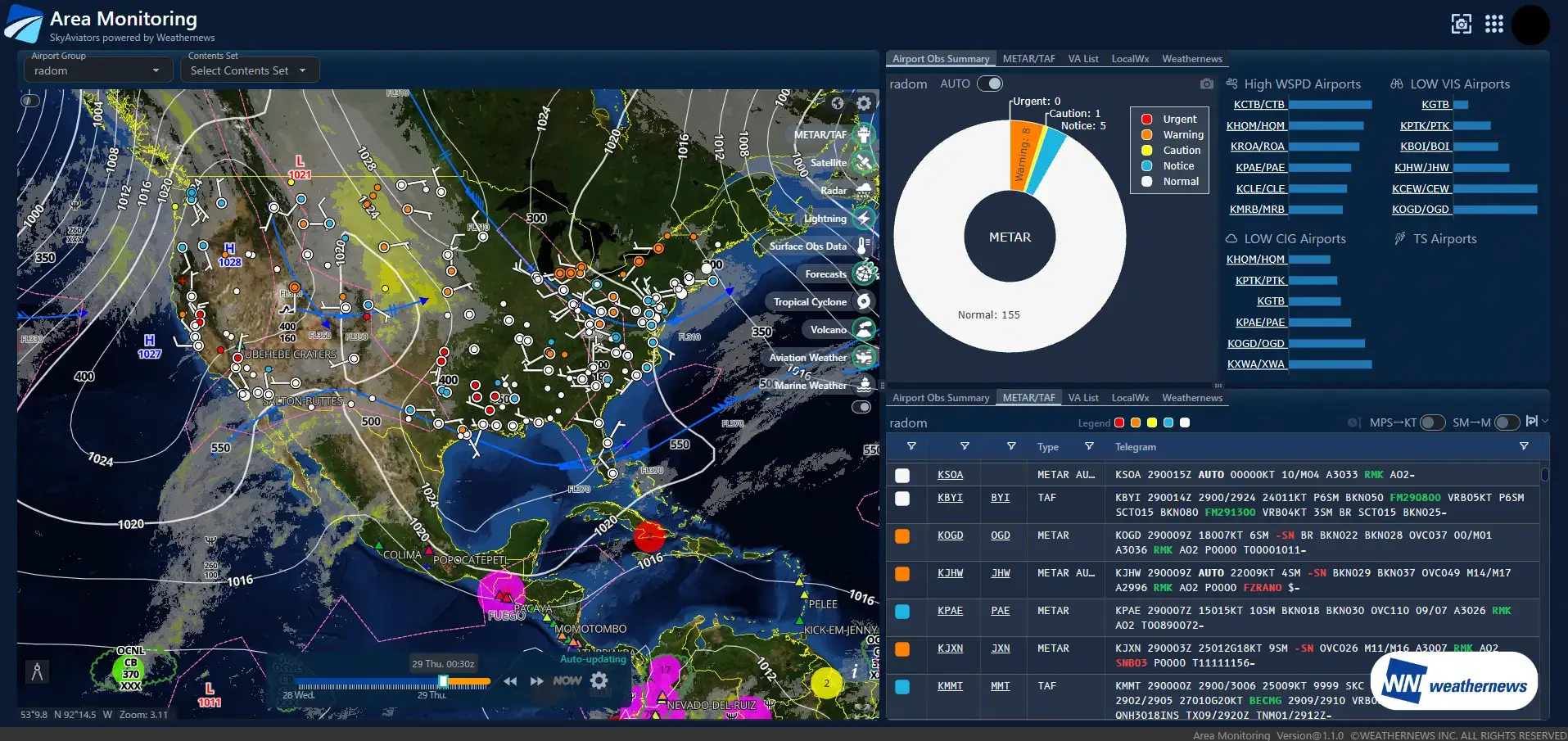
SkyAviators is a comprehensive weather intelligence platform developed by Weathernews for airlines. Powered by world-class meteorological data and decades of aviation weather expertise, it empowers operational decision-making when it matters most. The Airport Summary & Model Comparison feature integrates multiple numerical weather prediction models and ICAO-standard forecast reliability assessments into a single view. This enables users to quickly identify forecast discrepancies and uncertainty, supporting weather interpretation and decision-making aligned with airline operational policies.
Multiple numerical weather prediction models—including regional models, global models, and proprietary forecasts—are consolidated into a single view together with historical observation data.
Forecast reliability for each numerical model is visualized using evaluation methods based on ICAO standards.
Three numerical weather prediction models for the same region are displayed in parallel, enabling direct comparison under identical conditions.
Historical observations, current conditions, and future forecasts are seamlessly integrated into a time-series display.
Objective reliability assessments clarify which model should be used as the decision reference. This improves both the speed and confidence of Go / No-Go decisions, helping prevent delays in operational judgment.
Model reliability is standardized using ICAO-based evaluation methods, reducing reliance on individual expertise or personal judgment. This allows the entire team to apply consistent decision criteria.
When weather variability is high and decisions become challenging, multiple forecast models are compared and their confidence evaluated to provide reliable support for operational decision-making.
There is no need to switch between multiple websites or screens. By consolidating all relevant information into a single view, analysis time is reduced, allowing teams to focus on making decisions.
Please feel free to consult with us about implementation methods, features, or advancing specific considerations. We'll answer even the smallest questions.
We'll explain pricing details and provide specific content based on your site conditions so you can consider with confidence.
Free Quote
We'll explain in detail how to utilize features and the implementation process. Please feel free to consult with us.
Consider Implementation