

Airline Weather
Industry Solutions
Explore real-world use cases and solutions tailored to each industry's unique weather challenges.


Construction Weather

Logistics Weather

Facility & Plant Weather

Municipal Weather

Retail Weather

Energy Weather

Dam Weather

Insurance Weather

Agricultural Weather

School Weather

Event Weather

Sports Weather

Road Weather

Railway Weather

Climate Tech

Broadcasting Weather

Coastal Weather

Airline Weather

General Aviation Weather

Drone Weather
Weather Solutions
Industry Solutions
Top PageWeather Solutions
Cherry Blossom Forecasts × Inbound Demand — Value Beyond Operations
February 17, 2026 Weathernews

Weathernews publishes its proprietary forecasts each year for the blooming and full bloom timing of cherry blossoms (Somei Yoshino) across Japan as a press release. This cherry blossom forecast is one of the most widely recognized seasonal forecasts in Japan.
During the 2025 season, at the request of an overseas airline’s operations team, this cherry blossom forecast was shared as an English report. The forecast was praised for its accuracy, and it also generated strong interest as content supporting inbound travel promotion. Similar requests have already been received for the 2026 season. Here, we share one example of how weather forecasting can deliver value not only to operational decision-making but to the broader airline business.
On February 12, Weathernews announced its Third Cherry Blossom Bloom Forecast for 2026.
The blooming of Somei Yoshino is expected to begin in Tokyo on March 21, with Fukuoka, Kochi, and Yokohama expected to follow on March 22. From late March through early April, blooming is expected to progress across many areas of western and eastern Japan.
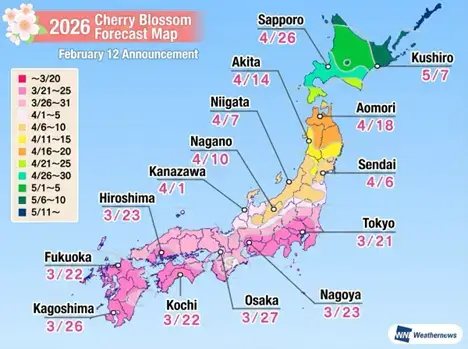
The cherry blossom season is a period when passenger demand on Japan routes rises sharply. For overseas airline operations teams, early visibility of blooming timing directly supports the following practical decisions
・Anticipating demand peaks The timing of blooming and full bloom tends to closely align with peak inbound travel demand. Early awareness of the forecast provides greater planning lead time for seat supply and aircraft allocation.
・Assessing regional route demand Beyond Tokyo and Osaka, cherry blossoms in Hokkaido and the Tohoku region reach their peak from late April to early May. The forecast serves as an important input for decisions on extra flights and charter services to regional airports.
・Alignment with marketing teams When operations teams share cherry blossom forecasts early, promotional campaigns by marketing teams can be synchronized with operational planning. In the 2025 season, this coordination contributed significantly to driving passenger demand.
Explore real-world use cases and solutions tailored to each industry's unique weather challenges.
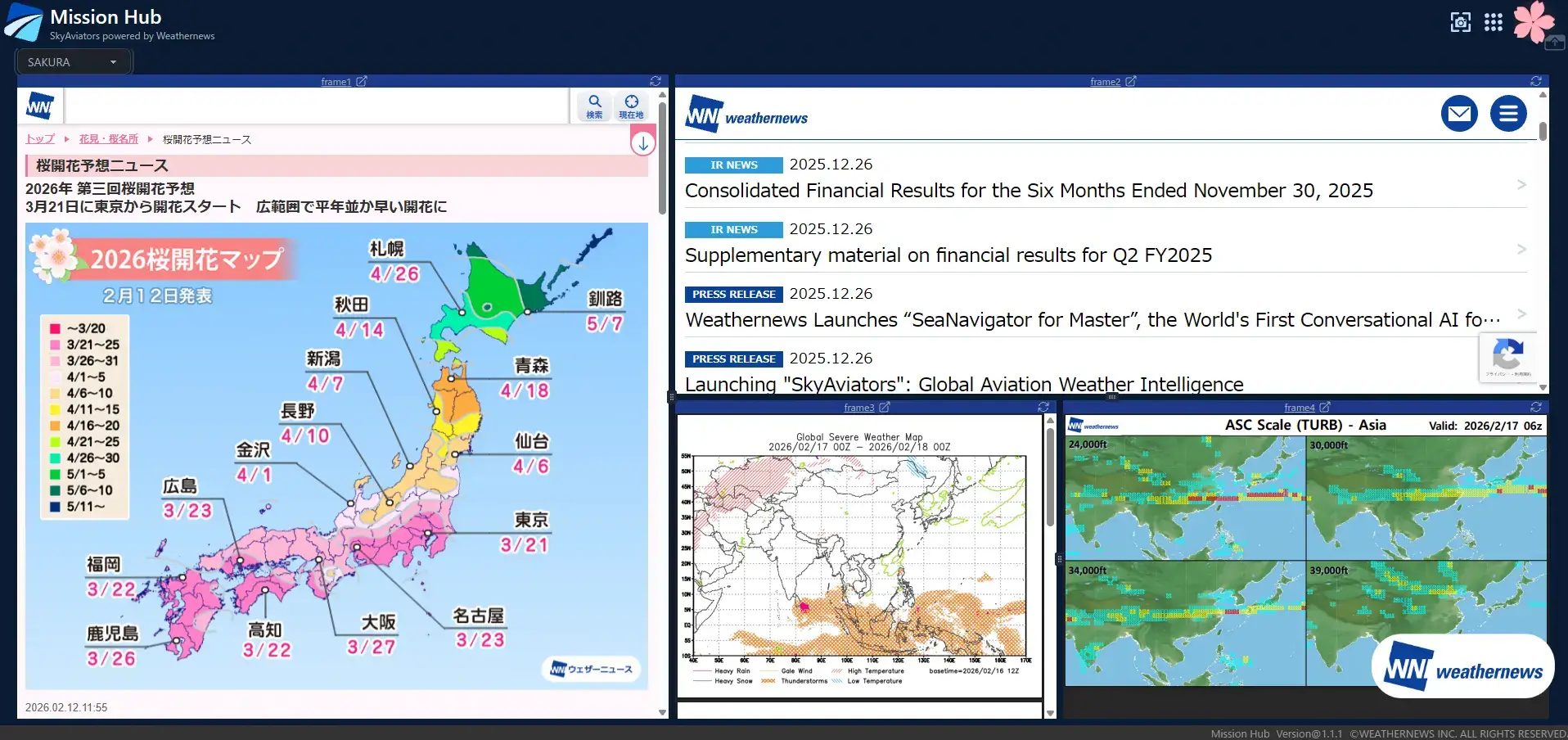
This is not a tool solely for IROPs response. From immediate severe weather response to seasonal forecasts, passenger-interest events, and major international events, it consolidates the key information required by airline operations teams into a single dashboard.
Relevant weather information, official agency announcements, and reference links are consolidated on one screen. There is no need to visit multiple sites, enabling immediate access to required information with a single click.
Quickly identify weather events that trigger IROPs, such as typhoons, heavy snow, thunderstorms, and volcanic ash. By connecting risk signals across multiple sources, teams can make faster, better-informed operational decisions — understanding not just what is happening, but why action is needed.
During typhoon season, track forecasts from multiple agencies are displayed in one view; during cherry blossom season, blooming forecasts are delivered; during earthquakes or floods, official agency information and weather data are integrated and displayed. The system focuses on the information that operations teams need right now, according to the current operational situation and risk phase.
Beyond IROPs, the system covers a wide range of information that may impact operations planning, including long-range outlooks (such as cherry blossom bloom forecasts, rainy season onset guidance, and monsoon outlooks), passenger-interest events (autumn foliage, ski season, festivals), and major international events (World Expos, international sporting events). Relevant external sources and reference links are aggregated and made accessible within the interface.
Eliminates the need to switch between multiple sites and screens. By consolidating necessary information onto a single screen, the environment allows teams to focus not on information gathering, but on decision-making itself.
Removes the hesitation of “where to look” during emergencies. While viewing the full risk picture at a glance, teams can make quick decisions aligned with operational policies.
Peak demand during cherry blossom season, monsoon onset timing, weather risks during major events — by understanding information several weeks to months in advance, the accuracy of aircraft and crew allocation optimization and capacity planning is improved.
Enables information sharing not only within operations but also with related departments such as network planning, marketing, and airport operations through PDF reports and briefing functions. Maintains consistent situational awareness across the entire team.
Please feel free to consult with us about implementation methods, features, or advancing specific considerations. We'll answer even the smallest questions.
We'll explain pricing details and provide specific content based on your site conditions so you can consider with confidence.
Free Quote
We'll explain in detail how to utilize features and the implementation process. Please feel free to consult with us.
Consider Implementation